All
Learn the SaaS customer support best practices that fast growing teams use to resolve tickets faster, reduce back and forth and scale support without hiring.

•
•

Most SaaS teams learn support best practices the hard way through missed service level agreements (SLA), frustrated customers, and tickets that sit unresolved for days while agents chase information that should have been there from the start.
The best teams don't stumble into good support. They build deliberate systems, capture the right information upfront and treat every ticket as data that makes their product better. Here is what they do differently.
Respond Fast But Resolve Completely
First reply time gets most of the attention. It's measurable, it's visible and it's easy to set targets around. But a fast reply that doesn't solve the problem isn't good support, it's just a quick acknowledgment that something went wrong.
The teams that consistently score highest on customer satisfaction do both. They reply fast enough to show the customer they have been heard and they resolve completely enough that the customer never needs to follow up.
In practice, this means:
Set realistic FRT targets by channel. Email and ticket based support warrants a different standard than live chat. Customers know the difference, set your SLAs accordingly.
Measure First Contact Resolution alongside FRT (first reply time). FCR (first contact resolution) tells you whether your fast replies are actually solving problems or just buying time.
Don't sacrifice resolution quality for speed. A slightly slower reply that closes the ticket permanently is almost always better than a fast one that reopens it two days later.
The tension between speed and quality is real but it's mostly a process problem. Teams that resolve quickly and completely usually have better information to work with from the start which is a function of how the ticket was captured, not how fast the agent typed.
Build a Tier Structure From Day One
The most common support mistake SaaS teams make isn't being slow or under resourced. It's treating every ticket as the same kind of problem which means everything gets the same level of attention regardless of urgency or complexity.
A tier structure fixes this and you don't need a large team to implement one.
Tier 1: Common questions and how to requests. These can be resolved with documentation, a short reply or a templated response. Any support agent should be able to handle these without escalation.
Tier 2: Account specific issues requiring investigation. Something isn't working as expected for a specific customer or account. Requires access to account data, logs or configuration but doesn't need engineering involvement.
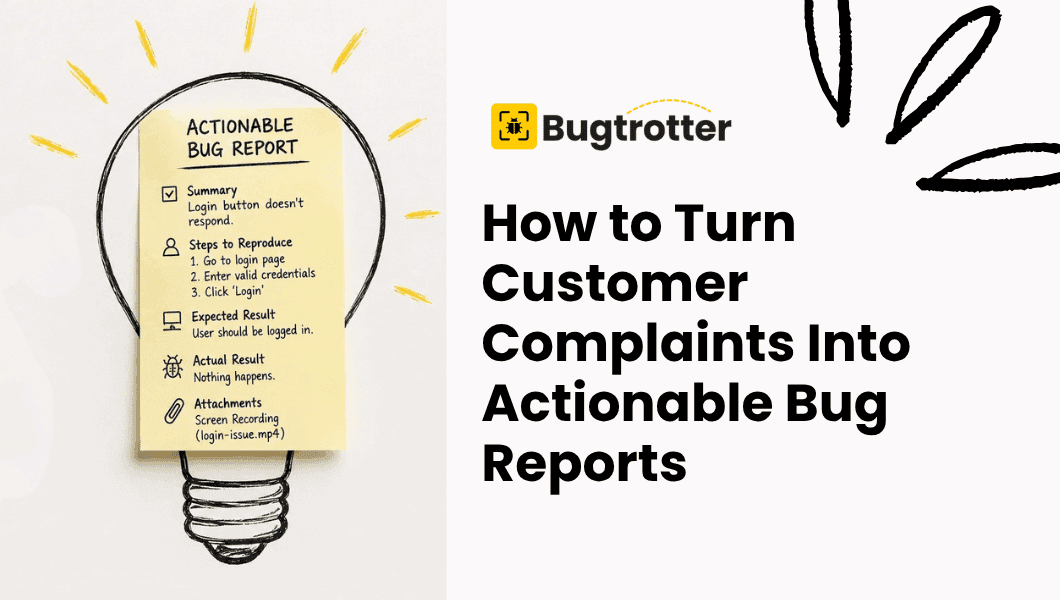
Tier 3: Bugs and technical issues requiring engineering. Something is broken in the product. Requires a structured handoff to engineering with enough context to reproduce and fix the issue without back-and-forth.
Defining these tiers clearly and training your team on which is which means tickets reach the right person faster, senior team members aren't pulled into Tier 1 issues and engineering gets what they actually need when a bug lands on their desk.
For a full breakdown of how to structure your support team as you grow from 10 to 100 employees, read our SaaS Customer Support: The Complete Guide (2026).
Capture Complete Information at the Point of Reporting
This is where most SaaS support operations lose hours every day without realising it not in the resolution but in the chase for context that should have been captured upfront.
The pattern is familiar. A customer reports something is broken. The agent asks for their browser. Then their OS. Then a description of what they were doing when it happened. Then a screenshot. By the time there's enough information to escalate to engineering, three days have passed and the customer has sent five messages they didn't expect to send.
Best in class teams don't operate this way. They capture complete context at the point of reporting, environment details, what the customer was trying to do, what actually happened before anyone on the support team has to ask a single follow-up question.
The difference isn't agent quality. It's how the report was submitted in the first place.
When we were building Warmcal, our support team averaged 3 follow-up messages per bug report just trying to gather enough information to act. That's not a people problem, it's a process problem. Text descriptions of software bugs are inherently limited. Customers don't know what information engineers need, and engineers can't reproduce bugs from vague descriptions.
Bugtrotter solves this directly. Instead of asking customers to describe what went wrong, It lets them record a short video of the issue happening in real time. The report that lands in your helpdesk automatically includes environmental data, everything your team needs to act immediately, captured without anyone having to ask.
This is exactly the problem Bugtrotter was built to solve: see how it works.
Close the Loop Between Support and Product
Support teams sit on some of the most valuable product data in the company. Every ticket is a signal about what's confusing, what's broken, what's missing and where customers are getting stuck. Most of that signal never reaches the product team in any structured way.
Closing this loop doesn't require a complex process. It requires one consistent habit: tagging tickets by root cause and sharing the patterns monthly.
Root cause tagging means categorizing tickets not just by topic, billing, bugs, onboarding but by the underlying reason they were filed. "Customer didn't know the feature existed" is a different root cause than "the feature exists but doesn't work as expected," even if both land in the same category.
When your product team sees that 40 tickets last month were filed because customers couldn't find a specific setting, that's actionable. When they see that a particular integration generates disproportionate bug reports, that's a prioritization signal. When they see that first week tickets cluster around the same two features, that's an onboarding problem with a clear fix.
Support data turns into product improvements. Product improvements reduce future ticket volume. The loop compounds over time but only if someone closes it.
Measure What Actually Matters
Not every support metric tells you something useful. The ones that do are the ones that connect directly to customer experience and team efficiency.
First Reply Time (FRT): How long between ticket submission and your first response. Sets the tone for the entire interaction. Fast enough to show customers they have been heard, slow enough that you're not cutting corners on the quality of that first reply.
Time to Resolution (TTR): How long from ticket open to ticket closed. This is where bug report quality has the biggest impact. Incomplete reports that require multiple follow-up exchanges before work can begin inflate TTR significantly often without anyone noticing that the delay happened before engineering even saw the ticket.
Customer Satisfaction Score (CSAT): A post-resolution rating from the customer. Tracks what TTR misses: whether the resolution actually solved the problem. Track it per agent and per ticket category to find patterns that aggregate scores hide.
First Contact Resolution (FCR): The percentage of tickets resolved without a follow-up from the customer. Low FCR is almost always a signal that incomplete information is coming in at the point of submission, a process problem, not an agent problem.
A dedicated breakdown of how to track, benchmark and act on these metrics is coming soon.
Document Everything Before You Scale
Documentation is the highest leverage investment a support team can make and the one most consistently delayed until it feels urgent, which is usually too late.
Every article you write today deflects tickets for years. Every process you document before your next support hire means they inherit a system instead of building one from scratch. Every known bug you record with full reproduction steps means the next agent who sees it doesn't have to start from zero.
The teams that scale support without proportional headcount growth almost always have strong internal documentation. The ones that struggle don't and they feel it most acutely every time someone new joins the team or a senior agent leaves.
A practical starting point:
Document your top 10 ticket drivers first. These are the issues that will recur regardless of how your product evolves. Getting these into your knowledge base is the single highest return documentation task you can do.
Write for your customers, not your team. Internal documentation and customer-facing help articles serve different purposes. Your help centre should use the exact language customers use in tickets not product terminology your team invented internally.
Assign documentation ownership. If no one is responsible for keeping it current, it goes stale. Set a monthly review cadence and assign it to a specific person.
Documentation built early compounds. Documentation built under pressure is always incomplete.
Final Thoughts
The SaaS teams with the best support operations in 2026 aren't necessarily the ones with the most agents or the biggest budgets. They are the ones that capture better information upfront, build processes that scale before they need to, and treat every ticket as a signal worth acting on.
Most of these practices cost nothing to implement. They cost time and intention — and they pay back every time a ticket resolves on the first exchange instead of the fifth.
View more articles
Learn actionable strategies, proven workflows, and tips from experts to help your product thrive.